
Clinical Nutrition in Marietta, Georgia
You’ve Changed Your Diet. Bought the Supplements. Why Are You Still Struggling?
You may have put considerable effort into getting well.
You’ve read the articles. Tried the dietary changes. Bought supplements that sounded like exactly what you needed. Perhaps something helped for a while—but you’re still arranging your day around how you feel.
It’s exhausting to keep making an effort without understanding what to do next.
At Alternative Health Atlanta, clinical nutrition begins with a question worth examining: Is your nutrition meeting the demands your body is placing on it?
Understanding why that matters starts with looking at food a little differently.

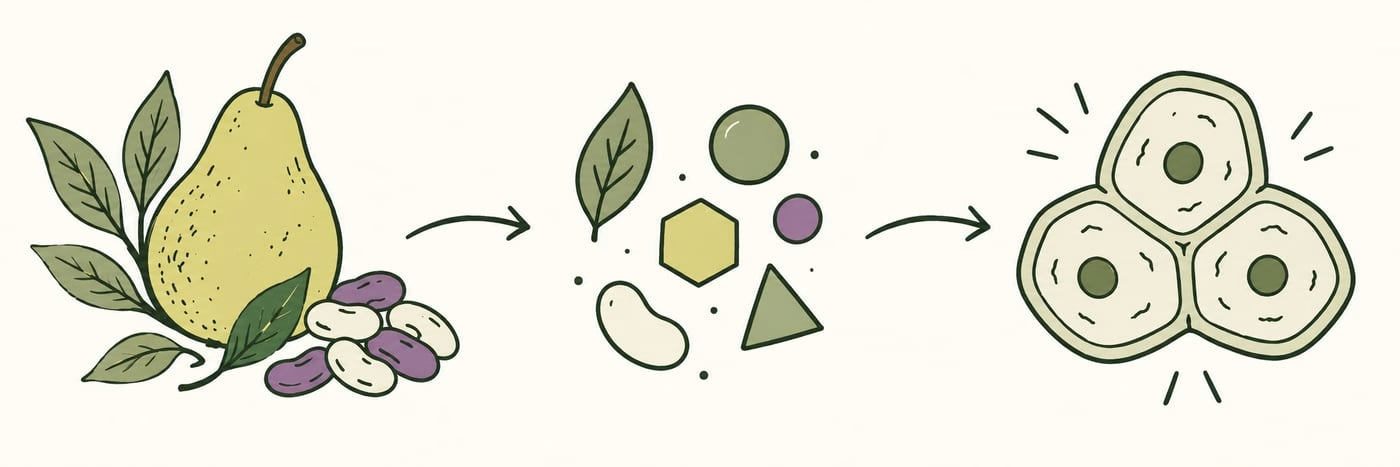
Food
Your meals supply the starting materials.
Nutrients
Digestion breaks food into components your body can use.
Maintenance & Repair
Your body uses nutrients to maintain cells and repair tissues.
Your Body Uses Food to Rebuild You
Think about the last time you scraped your skin. The damaged area gradually closed, and new tissue formed.
You didn’t consciously direct any of that work. Your body carried it out. But it needed energy and materials to do it.
Those materials come, in part, from your food.
During digestion, your body breaks food down into smaller components. It uses amino acids from protein to make its own proteins. Components of fats help form cell membranes. Vitamins and minerals support the processes that keep this work moving.
Your body takes food apart and uses its components to maintain and repair you.
That gives nutrition a much more immediate meaning than a list of foods you “should” eat. It connects what you eat with the work your body does every day.
A Remodeling Project Needs Materials
Imagine a remodeling crew arriving ready to work—but some essential supplies haven’t arrived.
More time and effort won’t substitute for the missing materials.
Tissue repair is more complicated than a construction project, but the comparison illustrates that a shortage of essential nutrients can interfere with repair and normal function.
“I eat healthy food” is useful information. It isn’t the whole assessment.
What You Eat Is Only Part of the Picture
You can put thought into your meals and still have questions worth exploring:
- Are you getting enough variety? A restricted diet can leave out important nutrient sources—even when every food you eat seems healthy.
- Are you absorbing what you eat? Some digestive conditions interfere with nutrient absorption.
- Have your needs changed? Illness and recovery can increase the demand for certain nutrients.
- What has your eating history been like? Long periods of inadequate intake or difficulty eating deserve attention, even if your habits have improved.
You shouldn’t have to diagnose yourself from a list on a website. These are reasons to take a closer look at your individual situation.
Where Supplements Can Help
Supplements offer a way to provide concentrated amounts of particular nutrients.
When a deficiency is present, correcting it helps restore the nutritional support needed for normal function and repair. The purpose matters: what is being recommended, what it is intended to address, and how the recommendation will be reviewed.
You deserve an explanation for every supplement in your program.
That includes how to take it, what it costs, and when we’ll reconsider whether you should continue it.
Before You Buy Another Bottle
Open the cupboard where you keep your supplements.
Are there half-empty bottles you stopped taking because you couldn’t tell whether they were helping? Products you bought after reading about a symptom? Several things you started at once, making it difficult to know what made a difference?
The missing piece may be a clear reason for each recommendation—and a plan for following up.
A symptom alone doesn’t tell you which nutrient you need. A compelling product description doesn’t establish that the product is appropriate for you.
Our approach begins with assessment and continues with reassessment.
We discuss your health history, concerns, diet, and current supplements. When appropriate, we recommend laboratory testing for additional information.
Our clinic also uses muscle-response testing as part of its assessment process. We explain how we use it, its limitations, and how it fits into our recommendations.
Before you begin a program, we take time to explain our reasoning and answer your questions.

Concerns, diet and what you have tried
Findings considered together, muscle response testing, labs when appropriate
A plan and an explanation for each recommendation
Review your experience and reassess
A Program You Can Understand and Follow

1. Start With Your Story
Your initial evaluation gives us time to discuss what has been happening, what you’ve already tried, and what you want to change.
We assess whether our approach is a good fit for your needs. You don’t need to arrive knowing which service or supplement to ask for.
2. Know What Is Being Recommended—and Why
At a second consultation, we review the proposed program together.
We discuss recommended supplements, any laboratory testing, suggested dietary changes, anticipated costs, and the estimated timeframe. You’ll have an opportunity to ask questions before deciding whether to begin.
3. Get Help Putting It Into Practice
A written recommendation is only useful if you can follow it.
We help you work through practical questions and difficulties. Dietary changes should have an understandable purpose and be manageable in your everyday life.
4. Review What Happens Next
At follow-up visits, we discuss your experience, repeat assessments used in your program, and review whether recommendations should change.
Tell us what is improving, what isn’t, and what is difficult. Those conversations are an important part of your care.
Clinical Nutrition at Alternative Health Atlanta
Clinical nutrition is a core part of our EvecticsSM approach, developed by founder Dr. Melodie Billiot. We provide personalized functional and holistic health services at our clinic in Marietta, Georgia.
Your proposed program may also include laboratory testing, acupressure, and diet and lifestyle coaching.
Explore our services or meet Dr. Billiot and our team.
You’ve Put Effort Into Your Health. Let’s Talk About Your Next Step.
If you’ve tried dietary changes and supplements without the results you hoped for, you probably have questions.
Start there.
A free discovery call gives you an opportunity to tell us what you’re looking for, ask about our approach, and learn what an evaluation involves.
Or call (770) 937-9200.
Alternative Health Atlanta
1640 Powers Ferry Rd SE
Building 14, Suite 100
Marietta, Georgia 30067